
Free AI attractiveness test
A free attractiveness test, with context.
Analyze one photo privately, then see how camera conditions and multiple views change what the result can support.
Quick Scan · Beta estimate
Start with one clear portrait.
Choose one clear portrait to begin.
What a careful test can observe
A photo can support observations about visible balance, feature relationships, symmetry cues, and presentation conditions. Those observations must stay tied to the image quality and viewpoint that produced them.
It cannot establish an objective beauty truth, a person's worth, health, character, compatibility, or how every viewer will respond. Those boundaries belong beside the result, not in fine print.

- Visible relationships. Relative spacing and proportions within a valid frame.
- Photo conditions. Lighting, perspective, crop, expression, and sharpness.
- Uncertainty. How much the available evidence supports a stable observation.
- 01ObserveCheck image quality, pose, visible spacing, and proportional relationships.
- 02QualifyMark one-photo structure as provisional and keep uncertainty visible.
- 03Do not inferDo not turn an image into a claim about worth, health, identity, or universal appeal.
Why multiple views are stronger evidence
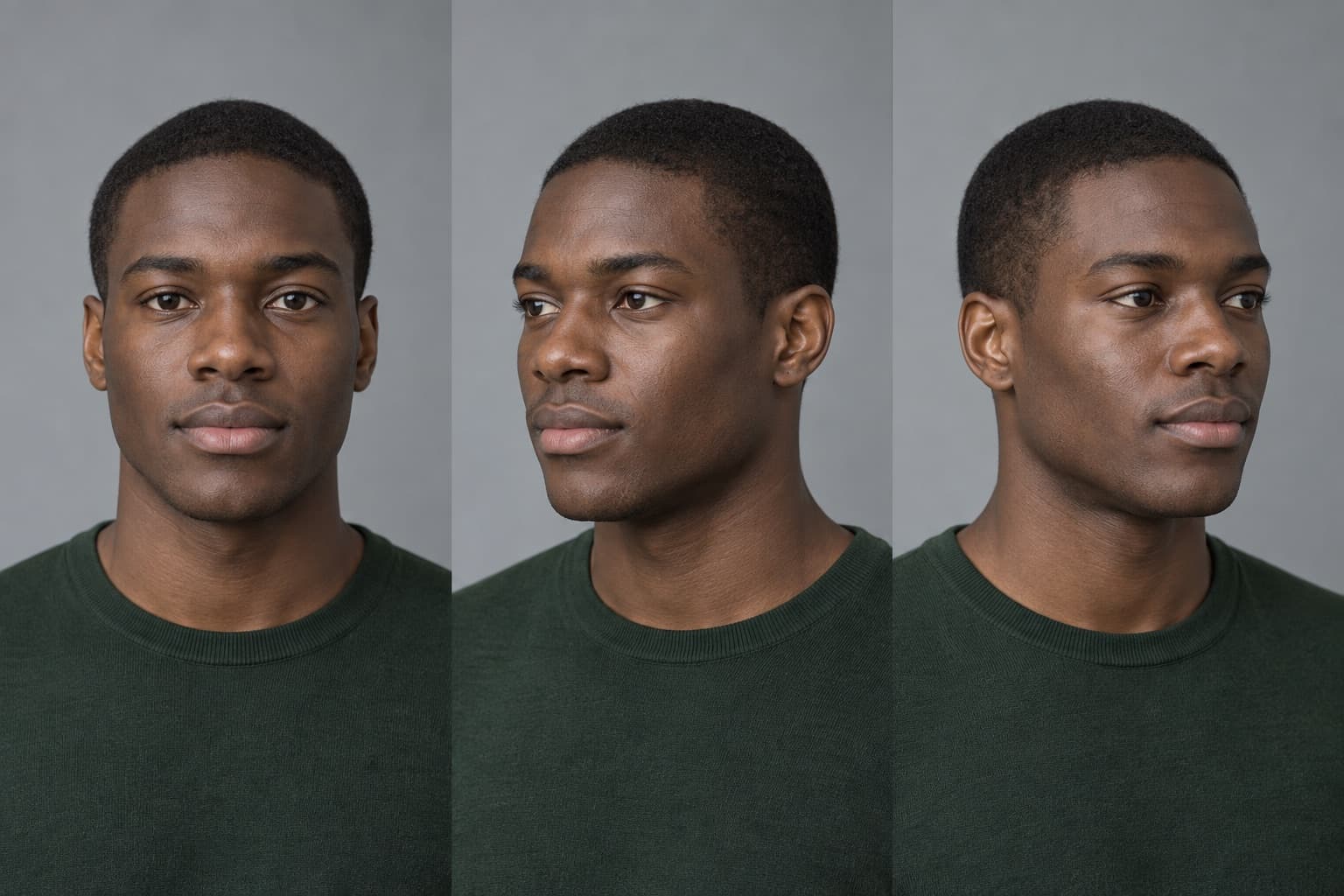
One image mixes facial structure with a specific camera position. Front, left 45-degree, and right 45-degree views make it easier to notice what persists and what changes with perspective.
A result should explain the evidence and its limits
A responsible output describes the evidence, names controllable photo factors, and shows uncertainty. It avoids insulting categories, competitive rankings, and promises of universal agreement.
Swipe sideways to view the full table.
| Output | What it may describe | What it must not claim |
|---|---|---|
| Photo conditions | Light, angle, crop, sharpness, and perspective | A permanent trait of the person |
| Visible relationships | Measurements supported by the accepted frame | A medical or identity conclusion |
| Confidence | Strength and agreement of the available image evidence | Accuracy, certainty, or universal agreement |
Ask a question the photo can answer
Ask how this photo presents, which conditions influenced it, and which visible observations remain consistent across better-controlled images.
For a practical next step, compare how photographic conditions change one impression. If the question is affecting self-worth, use the lower-harm “Am I Pretty?” guide while avoiding repeated score checks.
Reframe the questionQuick Scan is a single-photo Beta estimate
Quick Scan validates and analyzes one photo on a supported device. Its Photo Score and Provisional Structure Score use a frozen deterministic Beta engine. Blind validation has not passed, so the output remains a provisional photo analysis rather than a formal or universal rating.
Evidence and next reading
Use the closest guide for your next question.
Each link has a separate role; choose the one that matches what you want to understand next.
Questions, answered plainly
Questions about this analysis
Is an online attractiveness test objective?
No. Visible measurements can be consistent, but attractiveness also depends on culture, taste, context, and the conditions of the photo.
Can a test rate me from one selfie?
A selfie can only describe that frame. Close lenses, camera height, lighting, expression, and crop can change the presentation.
Why does LookRange use multiple views?
Multiple views can reduce dependence on one camera angle and show which observations remain more stable.
Can I take the test today?
Yes. Start with a free local Quick Scan, then add two controlled angled views for the complete three-view LookRange.